

Introduction
The thrilling clash between the New Orleans Saints vs Green Bay Packers Match Player Stats was one of the most anticipated games of the season. Both teams brought unique strengths and tactical styles to the field, making this matchup a showcase of contrasting strategies. In this article, we will break down the New Orleans Saints vs Green Bay Packers match player stats in detail — analyzing offensive, defensive, and special teams performances. We will also discuss how these numbers reveal the story of the game from start to finish.
Pre-Match Overview
Before diving into the New Orleans Saints vs Green Bay Packers match player stats, it’s important to understand the context of the game. The Packers entered the matchup with strong momentum, while the Saints were trying to regain consistency after a series of tough losses. The game was held at Lambeau Field, a setting known for its challenging cold weather — something that often benefits Green Bay.
Both teams had significant stakes in this contest:
- Green Bay Packers were aiming to strengthen their playoff position.
- New Orleans Saints were playing for pride and to test their younger talents in key positions.
The stage was perfectly set for a battle of endurance, strategy, and execution.
Passing Game Statistics
Packers Passing Performance
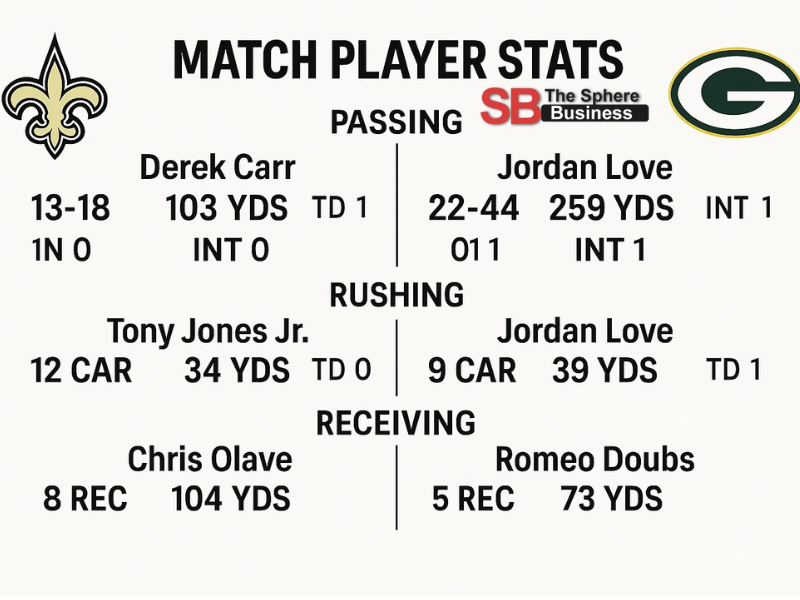
In the New Orleans Saints vs Green Bay Packers match player stats, the Packers’ passing game was efficient and disciplined. Quarterback Jordan Love completed 13 of 28 passes for 182 yards with one touchdown and no interceptions. While not an explosive yardage total, Love’s passing was characterized by smart decisions, quick releases, and solid game management.
Key Packers receiving contributors included:
- Jayden Reed – 3 receptions, 76 yards, provided deep-field threats and extended drives.
- Dontayvion Wicks – 1 touchdown reception, helping open the scoring.
- Romeo Doubs – contributed several short and medium-range catches that helped sustain momentum.
The Packers’ passing attack was balanced, prioritizing efficiency over risky long throws.
Saints Passing Performance
The Saints’ passing stats told a much different story. Quarterback Spencer Rattler struggled against the Packers’ defensive pressure, completing 15 of 30 passes for 153 yards, with no touchdowns and one interception. The Packers’ defense consistently disrupted his rhythm, forcing quick throws and limiting big plays.
Top receivers for New Orleans were:
- Chris Olave – 5 receptions, 61 yards, remained the most consistent offensive weapon.
- Rashid Shaheed – 3 receptions, 45 yards, showed flashes of speed but was contained effectively.
- Juwan Johnson – contributed a few key first downs but failed to impact the red zone.
Overall, the Saints’ passing struggles stemmed from poor pass protection and an inability to create separation against the Packers’ defensive backs.
Rushing and Receiving Stats
Packers Rushing Dominance
A major reason for Green Bay’s success was their strong ground game. The Packers rushed for 188 total yards, averaging nearly 5 yards per carry. Their rushing leader, Josh Jacobs, carried the ball 13 times for 69 yards and one touchdown. His consistent gains on early downs kept the Saints’ defense on its heels.
Supporting runners included:
- Jordan Love – contributed key scrambles for first downs.
- AJ Dillon – added 58 rushing yards, helping maintain a balanced attack.
This balanced rushing performance allowed the Packers to control the pace of the game and dominate time of possession.
Saints Rushing Struggles
The New Orleans Saints vs Green Bay Packers match player stats highlight one of the Saints’ biggest weaknesses: their running game. They managed just 67 rushing yards total, averaging only 3.4 yards per attempt.
Top rushers included:
- Alvin Kamara – 10 carries for 35 yards, often met in the backfield due to tight defensive coverage.
- Jamaal Williams – 6 carries for 21 yards, limited effectiveness against the Packers’ defensive line.
Without a successful run game, the Saints’ offense became predictable, forcing Rattler into passing situations where Green Bay could apply heavy pressure.
Defensive Player Stats
Packers Defensive Performance
The Packers’ defense was the most dominant unit on the field. They allowed only 196 total yards and forced two turnovers. The defensive line’s relentless pressure resulted in multiple sacks and disrupted nearly every Saints drive.
Top defensive contributors included:
- Rashan Gary – recorded 2 sacks and several quarterback pressures.
- Jaire Alexander – locked down the secondary, holding the Saints’ receivers to limited gains.
- Quay Walker – contributed 8 tackles and excellent run-stopping presence.
The Packers’ defense also excelled on third downs, holding the Saints to a conversion rate below 30%.
Saints Defensive Effort
While the Saints’ defense had moments of resistance, they ultimately couldn’t contain Green Bay’s balanced attack. They gave up over 400 yards of total offense and allowed consistent drives.
Defensive standouts for New Orleans included:
- Demario Davis – led the team with 9 tackles, showcasing leadership and grit.
- Cameron Jordan – applied some pressure on the edge but couldn’t convert it into sacks.
- Tyrann Mathieu – provided veteran coverage but struggled against the Packers’ tempo.
Despite individual efforts, the lack of team coordination led to breakdowns in coverage and poor run containment.
Turnovers and Special Teams Impact
Turnovers played a pivotal role in the New Orleans Saints vs Green Bay Packers match player stats.
- Packers: 0 turnovers – a clean offensive performance that emphasized discipline and control.
- Saints: 2 turnovers – including one interception and one fumble that directly led to scoring opportunities for the Packers.
These turnovers shifted momentum and kept the Saints from mounting any comeback.
On special teams, the Packers maintained their advantage with strong punting and field position control. The Saints, however, struggled to flip the field, often starting deep in their own territory.
Time of Possession and Penalties
Another key stat that defined the game was time of possession:
- Packers: 37 minutes, 13 seconds
- Saints: 22 minutes, 47 seconds
This massive difference reflected the Packers’ dominance in both offensive execution and defensive control.
Penalties also played a role:
- Saints committed 7 penalties for 40 yards, often stalling drives.
- Packers committed 6 penalties for 60 yards but were able to recover with consistent execution.
Tactical Takeaways from the Match Stats
The New Orleans Saints vs Green Bay Packers match player stats reveal key tactical insights:
- Efficiency over explosiveness – The Packers prioritized mistake-free football and capitalized on short fields.
- Defensive dominance wins games – Green Bay’s front seven controlled the trenches, dictating the pace of play.
- Ball control is crucial – By dominating time of possession, the Packers ensured their defense stayed rested.
- Saints’ offensive imbalance – Without a reliable run game, the Saints’ offense became predictable.
- Turnover margin matters – The Saints’ two turnovers and zero takeaways defined the final scoreline.
Standout Performers
Highlighting the top individual contributions in the New Orleans Saints vs Green Bay Packers match player stats:
- Jordan Love (QB, Packers) – 182 passing yards, 1 TD, 0 INT; excellent game management.
- Josh Jacobs (RB, Packers) – 69 rushing yards, 1 TD; consistent and physical performance.
- Jayden Reed (WR, Packers) – 76 receiving yards; crucial deep-play threat.
- Rashan Gary (LB, Packers) – 2 sacks, constant backfield disruption.
- Demario Davis (LB, Saints) – 9 tackles; played with heart despite limited team success.
- Chris Olave (WR, Saints) – 61 receiving yards; remained the only steady offensive option.
Lessons and Future Outlook
For the New Orleans Saints, the player stats point to key lessons:
- The offense needs balance between passing and rushing.
- Improved pass protection is crucial for quarterback confidence.
- Turnover prevention must become a top priority.
For the Green Bay Packers, the takeaway is that their formula is working: a balanced offense, disciplined defense, and mistake-free execution. If they continue this form, they will remain a strong playoff contender.
Conclusion
The New Orleans Saints vs Green Bay Packers match player stats tell a clear story of dominance, discipline, and execution. The Packers’ balanced offense, sturdy defense, and flawless ball security led them to a commanding victory. The Saints, meanwhile, struggled to find rhythm on offense and couldn’t overcome turnovers or defensive lapses.
In the end, this game showcased the importance of fundamentals in football — control the clock, protect the ball, execute efficiently, and you will win. The Packers’ player stats reflected a well-coached, cohesive team ready for the postseason, while the Saints’ numbers highlighted areas for growth and rebuilding.
The statistics may only be numbers, but in this matchup, they tell a complete story of how strategy, discipline, and execution defined the outcome.