


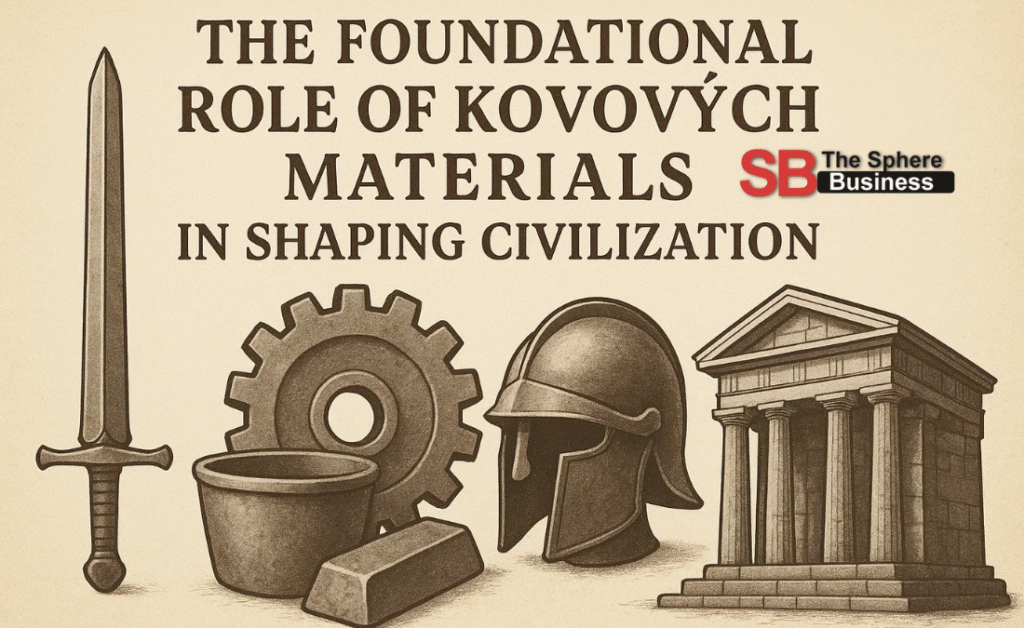
From the earliest bronze tools to the cutting-edge alloys aboard a spacecraft, the story of human progress is, in many ways, a story written in metal. The term “kovových” – a Czech word meaning “metallic” or “of metal” – serves as a perfect, all-encompassing descriptor for this vast and vital category of materials. It points not to a single element but to a universe of substances whose unique properties have enabled us to build, create, and innovate for millennia. This article delves into the world of kovových materials, exploring their fundamental properties, their journey through history, their modern classifications and applications, and the future innovations they promise.
Unveiling the Defining Properties of Kovových Substances
What truly defines a kovových material? The answer lies in a set of characteristic properties derived from their atomic structure, primarily the “sea of electrons” that surrounds a lattice of positive ions. This metallic bonding is the secret behind their most valuable traits.
First and foremost is high electrical and thermal conductivity. The delocalized electrons in kovových structures are free to move, allowing them to transport electrical charge and thermal energy with remarkable efficiency. This is why copper and aluminum form the backbone of our global electrical grid and why we use stainless steel or copper for cookware.
Secondly, kovových materials exhibit exceptional strength and hardness. While varying greatly between different metals and alloys, this mechanical robustness allows them to bear heavy loads, resist deformation, and withstand wear and tear. This makes them indispensable for structural applications, from the steel skeletons of skyscrapers to the engine blocks in our vehicles.
Another key property is malleability and ductility. Unlike brittle materials that shatter under force, most kovových substances can be hammered into thin sheets (malleability) or drawn into fine wires (ductility) without breaking. This allows for incredible versatility in manufacturing and shaping, enabling everything from intricate gold jewelry to the drawn copper wires inside electronics.
Finally, many kovových materials possess a characteristic luster—the ability to polish to a shiny, reflective surface. This aesthetic quality, combined with their durability, has made precious metals like gold and silver symbols of beauty and status for thousands of years.
A Historical Journey Through the Discovery of Kovových Elements
Humanity’s relationship with kovových materials defines our major historical epochs. The journey began in the Chalcolithic period, or Copper Age, when humans first learned to smelt and shape native copper. This was a revolutionary step beyond using stone and bone.
This innovation paved the way for the Bronze Age, the first true age of kovových alloys. By combining copper with tin, ancient metallurgists created bronze—a material significantly harder and more durable than its constituent parts. Bronze revolutionized warfare with better weapons, agriculture with stronger tools, and society as a whole, enabling more complex and durable artifacts.
The Iron Age marked an even more profound shift. Iron, particularly when carburized into steel, was far more abundant and, ultimately, stronger than bronze. Mastering the high-temperature furnaces needed to smelt iron was a monumental technical challenge, but its success laid the foundation for empires. The strength of iron weapons and tools granted military and economic advantages that shaped the ancient world.
Subsequent centuries saw the discovery and incorporation of other crucial kovových elements. The Romans advanced plumbing with lead, the alchemists sought to turn base metals into gold, and the 19th century brought the rise of aluminum and the precise alloying of steel, which directly fueled the Industrial Revolution. Each new metal or alloy unlocked new possibilities for technology and construction.
The Critical Importance of Modern Kovových Alloys
While pure metals have their uses, the true power of modern metallurgy lies in alloying—the process of combining a base metal with other elements to enhance its properties. This has given rise to an immense family of advanced kovových alloys, each engineered for a specific purpose.
- Stainless Steel: Perhaps the most famous alloy, stainless steel combines iron with chromium (at least 10.5%), which forms a passive layer of chromium oxide on the surface, making it highly resistant to rust and corrosion. It is a cornerstone of modern architecture, medical instruments, and the food service industry.
- Superalloys: These are high-performance kovových alloys designed to withstand extreme conditions of temperature, pressure, and stress. Primarily based on nickel, cobalt, or nickel-iron, they are essential for jet engines, gas turbines, and spacecraft components, where failure is not an option.
- Titanium Alloys: prized for their excellent strength-to-weight ratio and superb corrosion resistance. They are the material of choice for critical aerospace applications, high-performance automotive parts, and medical implants like joint replacements and dental roots, where biocompatibility is crucial.
- Aluminum Alloys: By adding elements like copper, magnesium, or silicon, the naturally light but soft aluminum is transformed into a strong, lightweight, and versatile material. These alloys are ubiquitous in the aerospace industry, modern transportation (cars, trains, ships), and packaging.
Contemporary Applications of Kovových Materials in Technology and Society
Today, kovových materials are so deeply embedded in our world that we often overlook their presence. Their applications are virtually limitless.
In infrastructure and construction, steel-reinforced concrete is the bedrock of our cities. The strength of steel allows for the creation of skyscrapers, long-span bridges, and tunnels, defining the modern urban landscape. Copper piping is standard for plumbing, and aluminum alloys are used extensively in building facades and window frames.
In transportation, the evolution from wooden carts to bullet trains is a story of metallurgical advancement. Modern vehicles are a complex mix of kovových materials: high-strength steel frames for safety, aluminum alloy wheels and body panels for fuel efficiency, and superalloy turbines in jet engines for propulsion.
In electronics and communication, the role of kovových materials is absolute. Copper is the primary conductor in virtually every circuit board and cable. Precious metals like gold and silver are used in connectors and switches for their superior conductivity and resistance to corrosion. Rare earth elements, which are often metallic, are critical components in the magnets of hard drives, speakers, and motors.
In medicine, the biocompatibility of certain kovových alloys has opened new frontiers. Titanium and cobalt-chromium alloys are used for orthopedic implants that bond with bone and withstand the stresses of the human body. Stainless steel instruments are staples in any surgical toolkit.
The Future and Sustainability of Kovových Resources
As we look to the future, the role of kovových materials will only expand, but it will also evolve amidst new challenges, particularly sustainability. The extraction and processing of metals are often energy-intensive and can have significant environmental impacts.
Future innovation will focus on several key areas. Advanced recycling is paramount. Creating a more circular economy for metals, where end-of-life products are efficiently collected and reprocessed into high-quality raw materials, reduces the need for virgin mining and conserves natural resources.
Material science is also pushing the boundaries of what kovových materials can do. The development of amorphous metals (metallic glasses), which have a disordered atomic structure, offers incredible strength and elasticity. Research into new high-entropy alloys (HEAs), which are composed of multiple principal elements, is yielding materials with unprecedented combinations of hardness, strength, and resistance to wear and corrosion.
Furthermore, the quest for new kovových materials is critical for the transition to green energy. Neodymium and other rare-earth metals are essential for the powerful magnets in wind turbines and electric vehicle motors. Lithium, cobalt, and nickel are the foundation of modern battery technology. Securing and responsibly sourcing these materials is a global strategic priority.
Conclusion
The Czech term “kovových” beautifully encapsulates the entire universe of materials that have been the bedrock of human advancement. From the primitive smiths of antiquity to the material scientists in modern labs, our ability to harness and improve these substances has directly dictated the pace of our progress. Their unique properties—strength, conductivity, malleability, and luster—have built our world, power our technology, and will undoubtedly form the foundation for the innovations of tomorrow. As we move forward, the challenge lies not only in discovering new kovových alloys but also in managing these precious resources with responsibility and foresight, ensuring they continue to serve civilization for millennia to come.