
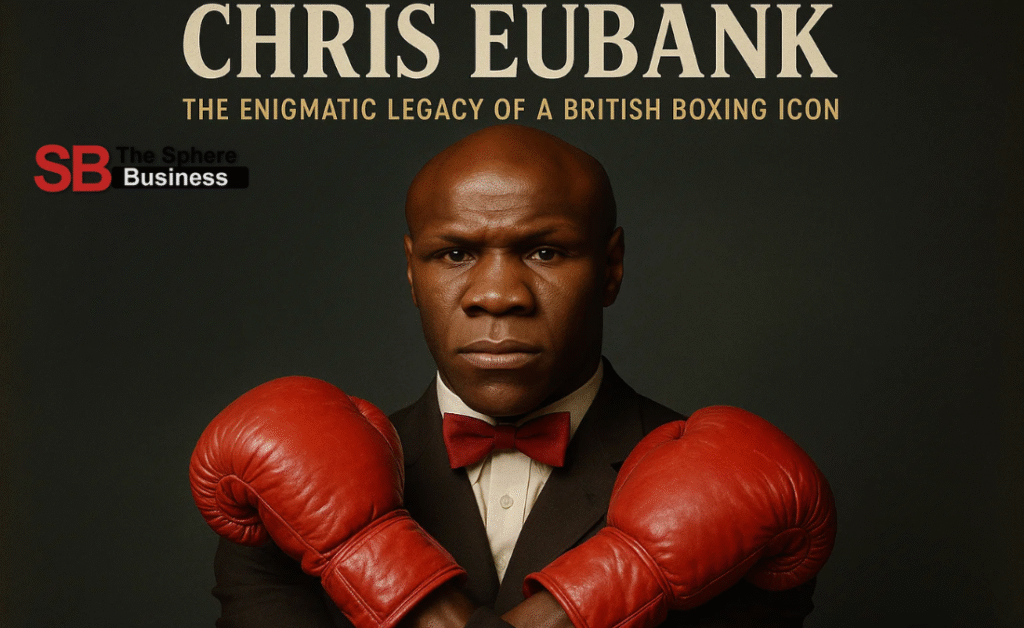

The name Chris Eubank is not just a name from the annals of British boxing; it is a brand, a persona, and a symbol of an era. To mention Chris Eubank is to conjure images of jodhpurs, a monocle, a haughty aristocratic air, and one of the most devastating right uppercuts in middleweight history. His career, spanning the late 1980s and throughout the 1990s, was a masterclass in self-promotion and sporting brilliance, a combination that made him one of the most recognizable, lucrative, and divisive figures in British sports. The story of Chris Eubank is a complex tapestry woven with threads of unparalleled showmanship, genuine fighting heart, and profound personal tragedy.
Chris Eubank: The Creation of “Simply The Best”
The persona of Chris Eubank that the British public came to love and loathe was a meticulously crafted character. Born in Dulwich, London, but having spent his formative years in the tough South Bronx, New York, Eubank returned to the UK with a unique perspective. He understood the power of image and narrative. He transformed himself from plain Christopher Eubank into the eccentric, arrogant, and utterly captivating “Simply The Best.”
His ring walks were theatrical performances. Dressed in riding boots and jodhpurs, often accompanied by classical music, he would stop to pose on the stairs, peering down at the roaring crowd through his trademark monocle. He spoke in a peculiar, verbose, and deliberately pompous manner, referring to himself in the third person. This act was genius. It sold tickets. People either paid to see him win and validate his arrogance, or they paid in the hope of seeing him humbled. The character of Chris Eubank was a commercial goldmine, but it often overshadowed the phenomenal athlete underneath the facade.
Chris Eubank: The Fierce Rivalries That Defined an Era
The legend of Chris Eubank is inextricably linked to his legendary rivalries, which formed the backbone of British boxing’s golden age. These were not just fights; they were cultural events that captivated the nation.
His feud with Nigel Benn was arguably the most intense in British boxing history. Their first fight in 1990 was a brutal, savage war for Benn’s WBO middleweight title. Chris Eubank emerged victorious with a ninth-round stoppage, announcing his arrival at the very top. The rematch in 1993, for Eubank’s WBO super-middleweight title, was an even bigger event, ending in a controversial draw that left the nation debating for weeks. The sheer animosity and contrasting styles—Benn’s ferocious “Dark Destroyer” against Eubank’s calculated arrogance—created an electric atmosphere that has rarely been matched.
Then there was Michael Watson. Their first fight was a points victory for Eubank. The rematch in 1991 was tragically life-altering. After a brutal contest, Eubank secured a late technical knockout in the 12th round. Watson collapsed in the ring, suffering a near-fatal brain injury that required multiple surgeries and left him permanently disabled. This event profoundly changed Chris Eubank. The showman was replaced, at least for a time, by a sombre, reflective man who was deeply affected by the terrible cost of their battle. He visited Watson in hospital and later supported his recovery, a chapter that added a layer of depth and humanity to his often-caricatured personality.
His rivalry with Irish star Steve Collins also defined the latter part of his career. Collins, who employed sports psychologist tricks to get inside Eubank’s head, famously defeated him twice, handing Chris Eubank his first professional losses and effectively ending his reign at the top.

Chris Eubank: The Fighter Behind the Persona
Beneath the theatrics and the verbose interviews, Chris Eubank was an exceptional and highly unorthodox boxer. He was not a volume puncher; he was a methodical, counter-punching technician with immense physical strength and perhaps the hardest chin British boxing has ever seen.
His style was built on a solid, hands-low defence, incredible upper body movement to slip punches, and a laser-guided right hand. His most feared weapon was his right uppercut, a punch that could end a fight in an instant. He possessed phenomenal heart and resilience, often digging deep in the later rounds to secure victories when behind on points. He held the WBO middleweight title from 1990 to 1991 and the WBO super-middleweight title from 1991 to 1995, making 14 successful defences of his world titles combined. This record is a testament not to a loudmouth, but to a dedicated, disciplined, and supremely gifted athlete.
Chris Eubank: Life After Boxing and a Lasting Legacy
The transition from sports star to civilian life is often difficult, and for Chris Eubank, it has been a journey played out in the public eye. He has remained a media personality, appearing on reality television and as a pundit. He became a father, and his son, Chris Eubank Jr., has followed in his footsteps, becoming a world-class boxer himself. The dynamic between father and son—as trainer, manager, and often critic—has added a new, modern chapter to the Eubank story.
Tragically, his family has also known profound loss. His nephew,,, and more recently his son, Sebastian Eubank, who died suddenly in 2021, which brought a wave of public sympathy for the family. These events have shown a vulnerable side to the man who once seemed impenetrably arrogant.
His legacy is multifaceted. He is remembered as the man who brought showbusiness to British boxing, paving the way for future stars like Anthony Joshua and Tyson Fury to build their own personal brands. He is remembered for his epic wars with Benn and Watson. And he is remembered for the tragedy that befell Watson, an event that led to crucial safety reforms in the sport, including the reduction of title fights from 15 to 12 rounds.
Conclusion: The Complex Portrait of a British Original
To define Chris Eubank is to accept contradiction. He was the arrogant villain the crowd loved to hate, yet he displayed immense courage and vulnerability. He was a master of psychological games, yet was himself deeply affected by the psychological trauma of his sport. He was a figure of immense fun and pantomime, yet his career is marked by one of the sport’s darkest tragedies.
Chris Eubank was more than a boxer; he was a phenomenon. He transcended his sport to become a true British icon, for better and for worse. His story is one of brilliant self-invention, undeniable sporting excellence, and deep human complexity. The character of “Simply The Best” may have been a construct, but the fights, the passion, and the impact of Chris Eubank were undeniably, powerfully real. His place in the history of British sport is not just secure; it is unique.


